
For growing Canadian small and medium-sized businesses (SMBs), what started as a flexible, cost-effective tech strategy often evolves into a primary bottleneck to scale. While SMB software is meant to streamline operations, an unintegrated stack creates operational friction, distorts reporting, and quietly erodes profitability.
How Canadian SMBs Fall Into the Tools Trap
No business owner sets out to build an overly complicated software ecosystem. The tools trap happens incrementally, driven by fast growth and reactive decision-making:
Phase 1: Bootstrapping with Point Solutions
At inception, the focus is speed and cost. Departments pick best-of-breed business software tools that solve immediate single-use problems without considering long-term cross-departmental integration.
Phase 2: Organic Growth and Silo Creation
As sales reps, project managers, and finance teams grow, each department optimizes its own ecosystem. Sales lives in HubSpot, operations runs on Monday.com, and accounting operates inside QuickBooks or Xero. Each team functions well within its own silo, but the systems do not communicate with one another.
Phase 3: The Workaround Era
To bridge the gaps between systems, teams turn to manual copy-pasting, CSV exports, or third-party automation tools like Zapier. While this paper over the cracks temporarily, these workarounds are fragile. A single API change or minor update can break the data pipeline overnight without warning.
The Business Impact of Disconnected Software
When disconnected software reaches critical mass, the consequences hit every layer of the organization.
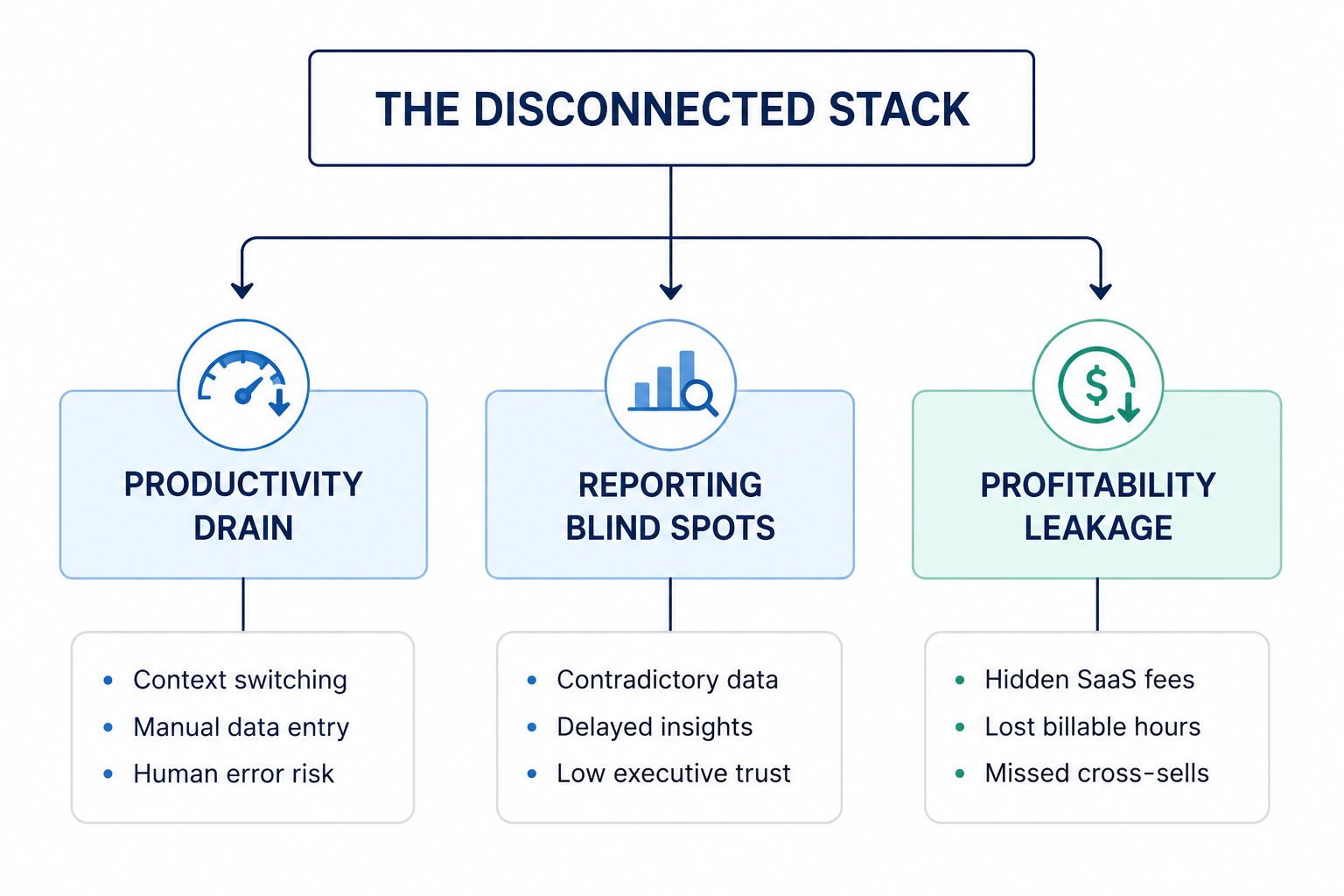
1. Productivity Drain: Context Switching and Data Entry
Real-World Example: Consider a growing HVAC and mechanical services company in Calgary. The field technicians log completed service jobs in a specialized dispatch app. However, because that app isn't connected to the central accounting software, an admin staff member spends every Friday afternoon manually re-entering 50+ job tickets into the invoicing system. A single typo in an hourly rate or parts total creates invoice disputes that delay payment by weeks.
2. Reporting Blind Spots: Multiple Versions of the Truth
- Marketing reports 100 new leads from the CRM.
- Operations shows 60 active projects in their management tool.
- Finance shows revenue for only 45 clients because invoicing hasn't caught up.
3. Profitability Erosion: Unseen Overhead and Churn
- SaaS Waste: Unused or redundant licenses across teams silently add hundreds or thousands of dollars to monthly overhead.
- Customer Friction: If a client reaches out to support and the representative cannot see their recent order history or active service ticket because it’s trapped in a separate system, the customer experience drops—leading to churn.
- Missed Opportunities: Sales representatives miss upsell opportunities because they have no visibility into whether a customer is experiencing project delays or billing issues.
Why Canadian SMBs Face Unique Pressures
- According to a report by the Canadian Federation of Independent Business (CFIB), while 92% of Canadian small businesses utilize digital tools, only 10% have fully integrated them across their operations.
- CFIB’s research reveals that fully integrated "digital leaders" see a $2.40 return for every $1 invested in technology—compared to just $1.60 for less integrated counterparts.
- With Canada facing a persistent national productivity gap relative to international peers, eliminating administrative drag is one of the fastest ways for local businesses to protect their profit margins.
Escaping the Trap: From Disconnected Apps to Unified Architecture
Outgrowing a software stack is a natural sign of business success—it means your operations have matured beyond basic toolkits. To break free from app bloat, SMB leaders should consider a structured approach to modernizing their stack:
- Audit Your Tech Stack: Map out every software tool currently in use across departments, including subscription costs, active users, and data flows.
- Identify Core Integrations: Prioritize solutions that offer robust, native integrations or look toward unified ERP/CRM platforms that bring marketing, sales, operations, and finance into a single source of truth.
- Establish Data Residency & Governance: Ensure any consolidated system complies with Canadian privacy standards (like PIPEDA) and offers Canadian data residency options where required.
Ready to Simplify Your Software Stack?
If disconnected tools are slowing down your team, now is the time to simplify your technology roadmap. Book a discovery call to review your current software stack, identify integration gaps, and explore a practical path toward a more connected, scalable system.